|
 |
 |
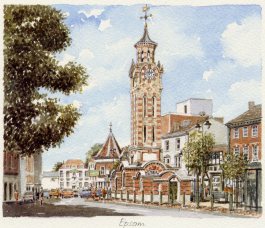
This encouraged the development of The Railways from Croydon (1847) and Wimbledon (1859). Further lines were completed, mainly for race-goers, to Epsom Downs (1865) and Tattenham Corner (1901). The increasing pulse of life in the town encouraged the local authority (then known as the Vestry) to rebuild the Watch House, which stood beside the pond and housed a fire engine. They replaced it with the Clock House which still stands today.
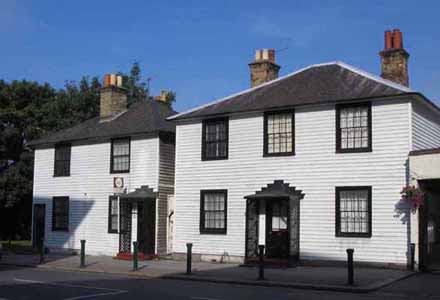
Epsom now had 600 houses, including about 200 of the traditional "clapboard" houses, a few of which still survive. Health became an increasing problem, and a local board of health was elected in 1850. They made sewers and filled in the town pond. Great building schemes were mooted, initially for the area of Epsom Common, but these were abandoned. Instead, the common fields to the south and east were enclosed in 1869 and gradually divided up into building plots. In 1895, another great expansion started when Epsom Court Farm was divided up for building. The Board of Health was superseded in 1895 by an Urban District Council. Another major development at this time was the building by the London County Council of three large mental hospitals on the western outskirts of the town: Manor (1899), Horton and St. Ebba's (1901) and Long Grove (1907). Most of these magnificent buildings have now been abandoned as hospitals, in favour of "care in the community". The buildings remain as a monument to the Victorian drive and energy for schemes of public welfare.
The foundations of Epsom's excellent parks system was laid when the Earl of Rosebery gave the land for Rosebery Park in 1913.
In 1934, the Urban District of Epsom expanded to include its sister
community of Ewell, and in 1937 the Council received its charter creating
the Borough of Epsom and Ewell.
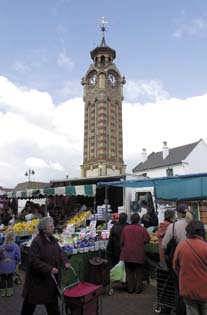
Epsom is a Market Town with stalls set up every Thursday, Friday and Saturday in the Square around the Clock Tower.
|
|
|
|
|
||